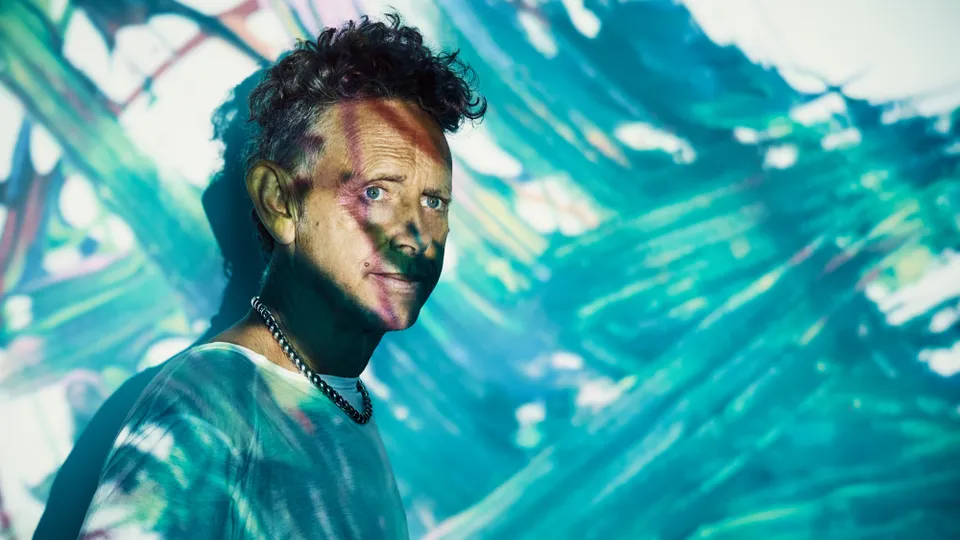
Lots of trivia about the making of ‘The Third Chimpanzee’, the effect of the pandemic on his studio work and family life, the disastrous consequences of Brexit on music tours (note that musician visas for US tours have tripled in price).
Yet another curiosity on why we translators are needed:
The original title is ‘In der Pandemie ist es schwierig, kreativ zu sein – täglich grüßt das Murmeltier’
The machine translation would translate: ‘During the pandemic it is difficult to be creative. Every day the groundhog greets you.’
Actually, ‘Täglich grüßt das Murmeltier’ is the German title of the 1993 film Groundhog Day, Ricomincio da capo (in Italian). In the film, the main character, Phil, has to travel unwillingly to the small town of Punxsutawney, Pennsylvania, to report on the traditional Groundhog Day (a holiday celebrated in the US and Canada on 2 February), which he has been attending for four years now. Here, however, he is trapped in a time loop: every morning, at 6 o’clock on 2 February, he is woken up by the radio playing the same song (I Got You Babe by Sonny & Cher), and from then on, the day passes inexorably in the same way as the previous one. Events repeat exactly the same every day.
That is why there is this reference in the title to the groundhog who greets you every day.
That’s why the translation of the title is actually: ‘It’s hard to be creative during the pandemic – Every day is the same.’
Could an AI understand something like that? I don’t think so. Could it translate a figure of speech correctly? I don’t think so.
OK, enough with the rambling, let’s move on to the interview. Viel Spaß beim Lesen!
Martin Gore of Depeche Mode
‘It’s hard to be creative during the pandemic – every day is the same.’
The musical mind of Depeche Mode has recorded a new solo EP. Here Martin Gore talks about his daily life in his home studio and explains what monkeys have to do with his life during the coronavirus.
Interview by Felix Bayer
01.02.2021, 3.10 p.m.
Martin Lee Gore, 59, co-founded the band called Depeche Mode in the southeast English town of Basildon, taking its name from a French fashion magazine. After Vince Clarke left the group, Gore became its main songwriter, composing and writing the songs that made Depeche Mode the world’s most successful synth-pop band in the 1980s and 1990s. Outside the group, Gore recorded two albums of covers and two albums of electronic instrumentals (one with Vince Clarke, the other solo). Now his new EP ‘The Third Chimpanzee’ is out, again featuring instrumental tracks. Martin Gore lives in Santa Barbara, California, with his second wife and two daughters. He has three more children from his first marriage.
SPIEGEL: Martin Gore, do you know whether monkeys perceive music? Have you done any research on that?
Gore: No, not really.
SPIEGEL: According to everything I’ve found out, monkeys apparently like sounds that sound like monkeys….
Gore: That makes sense.
SPIEGEL: At least you’ve found a monkey that can create art. Pockets Warhol, who painted the picture on the cover of your new EP. Were there any specifications on your part?
Gore: Well, after contacting the shelter, I mainly dealt with a lady called Charmaine, who called herself Pockets’ muse. I asked her if it would be possible for him to paint on twelve by twelve inch canvases, and in vinyl format. Apparently, he usually works on rectangular canvases. Charmaine then asked me what colours I preferred and provided him with a suitable palette. That’s it, that’s my contribution.
SPIEGEL: Apart from that, the artist had complete creative freedom. Did he listen to his music while he was painting?
Gore: No, this was at quite an early stage, before the pieces were finished.
SPIEGEL: The monkey concept starts with the title of the EP, ‘The Third Chimpanzee’. It refers to a book by biologist Jared Diamond. What fascinated you in particular?
Gore: I read it when it came out in the early 1990s. If I remember correctly, I was particularly struck by the fact that the differences in genes between humans and chimpanzees are less than two per cent. Obviously, this two per cent has an enormous effect.
SPIEGEL: Diamond is quite critical of what we humans have done with this small difference. In particular, he blames agriculture for many negative developments. Have these considerations also been taken into account?
Gore: Well, I only dealt with the general concept. But what you say about agriculture fits in a bit with what Yuval Noah Harari writes in ‘Sapiens’. He too points out that we think we are constantly making progress when in fact we are not, at least potentially.
SPIEGEL: The individual tracks on the EP are named after different ape species: howler monkey, mandrill, capuchin monkey, vervet monkey. How did you choose them? By leafing through a picture book with your young children?
Gore: Haha, no. The first song I worked on was ‘Howler’ and it sounded like real howler monkeys in the wild. I regularly go on holiday to Costa Rica once a year or every two years when there is no pandemic. There are a lot of howler monkeys there, you can hear them all the time.
SPIEGEL: Is this EP your creative project for the time of the coronavirus? Or were you already working on the tracks?
Gore: I already had a demo for ‘Howler’ when the pandemic broke out. But then I thought I should do something productive with my time. For some reason, I felt strangely unmotivated to write lyrics.
SPIEGEL: How did that happen?
Gore: I don’t know if I’m analysing with the benefit of hindsight, but it partly had to do with the fact that there was little stimulation. We’re all at home and every day is the same. We always see the same handful of people, we don’t travel. That makes it really difficult to be creative, especially as a lyric writer.
SPIEGEL: What is daily life like at the Gore home during the coronavirus pandemic? Is it more difficult to sneak into the studio because of childcare?
Gore: I know I am very lucky because I have not had to change my life much because of the pandemic. My wife is very understanding, she realises that I, well, work in the afternoons. I have limited my studio hours a little bit, I go at one o’clock in the afternoon, after lunch, and work until six. Monday to Friday.
SPIEGEL: So regularly? Because that’s the best way to organise yourself?
Gore: Yes. And of course it’s also a place of retreat. There are also days when I go to the studio and I don’t feel particularly creative. But then I don’t say: ‘Phew, I don’t feel like working today, I’ll go home and relax’. It’s also nice to relax a bit, strum the piano or play with some device. It distracts you from things, which is good for your mental health.
SPIEGEL: Parts of the EP sound a bit like an homage to the pioneers of synthesisers who experimented like scientists, connecting cables and turning knobs until the right sounds came out. Do you see your work in this tradition?
Gore: That’s what I do. This time I worked with everything that was around: old synthesisers, new analogue modular devices, but also digital sounds. I like to play as much as I can until something comes out that can form the basis for a song.
SPIEGEL: How does the process work, whether what comes out of experimentation becomes a solo track or the basis for a Depeche Mode song or something completely different?
Gore: Well, I had a concept and I worked with that in mind. It’s not like I do something and then I think if it’s good for Depeche or something else. I focused on writing instrumentals and finding interesting things for them. Of course there’s always something that doesn’t fit, but then I throw it away.
SPIEGEL: So you don’t have an idea drawer where you put things that might be interesting later on?
Gore: I don’t have a big archive or anything like that. Sure, there’s a folder where I keep ideas that didn’t work out. From time to time I listen to something in there and if I find something absolutely horrible, I delete it.
SPIEGEL: Your colleagues in Depeche Mode have a lot of respect for the way you work, which is understandable. Dave Gahan sent you ‘Off to the studio’ in the lovely video in which you thanked the band for being inducted into the Rock and Roll Hall of Fame in November.
Gore: That’s right.
SPIEGEL: How much do you regret the fact that the pandemic deprived you of a proper induction ceremony?
Gore: Well, it’s not without a certain irony that Depeche Mode managed to get inducted in the very year that there’s a pandemic. It’s funny. But we’re just happy to have been accepted and we consider it an honour.
SPIEGEL: One of the things you can’t do for musicians at the moment is, of course, go on tour. However, there has recently been a dispute about touring: British musicians published an open letter asking to be allowed to perform in Europe without a visa even after Brexit. Did you notice this? Did you also sign it?
Gore: To be honest, I haven’t heard about it. I live in the US and it was not a topical issue. But I’m not surprised at all. It was the first thing I thought when I heard about Brexit: that it would be a real nightmare.
SPIEGEL: So you don’t think much about Brexit?
Gore: No, I can’t understand why people were in favour of it. It is fortunate that there is now at least a trade deal. Otherwise it would have been a disaster
SPIEGEL: However, the agreement contains nothing on the issue of musicians.
Gore: Can it not be regulated? It must be possible to regulate it.
SPIEGEL: The blame for the non-agreement is being shifted between London and Brussels.
Gore: Let’s hope they can find a solution.
Link to original article:
https://www.spiegel.de/…/depeche-mode-martin-gore-ueber…
 Musica come Antidoto
Lascia un commento